Key takeaways
- This test looks for TB DNA in body fluid, not in sputum and not in blood. Different samples answer different questions.
- PCR is far more sensitive than the smear slide. A negative smear on body fluid never ends the story.
- The reflex Ultra step checks rifampicin resistance automatically from the same sample, with no second collection.
- Fluid is collected by a doctor at a clinic or hospital with local anaesthetic. No fasting is needed.
- Detected or not detected on the report is evidence, not the diagnosis. Your doctor reads it with symptoms, scans and other tests.
- Not detected does not fully rule TB out. Sensitivity runs from about 50 percent in pleural fluid to over 90 percent in other fluids.
- TB outside the lungs is common, recognizable and treatable once found.
Book tests from this article
Sample collected at home - free
- Adenosine Deaminase (ADA)(Pleural fluid)
₹1,049₹1,39925% off
- AFB - M.Tb Detection with Rifampicin resistance by CBNAAT Sputum
₹3,599₹4,79925% off
Free collection 24 hr reports
The prescription line looks like a dare. AFB-DNA (TB-PCR) on body fluid, with reflex to rifampicin resistance by Ultra CBNAAT. Your doctor underlined the word "body fluid" and moved on to the next patient.
So here is the short answer, before anything else.
This test does not look for TB in your sputum or your blood. It looks for the TB bacterium's DNA inside a sample of fluid taken from somewhere it shouldn't be: around your lungs, in your belly, near your brain's covering, inside a joint, or inside an abscess. The "reflex" part means the lab does two jobs on that one sample without you coming back. First, it checks whether TB DNA is present at all. Second, if the answer is yes, it automatically checks whether those bacteria carry resistance to rifampicin, one of the main first-line TB drugs. One bottle, one collection, two answers.
You are not being sent to this test because something went wrong. You are being sent because doctors have learned that TB is a far sneakier tenant than the cough-and-spit version most of us picture.
Where TB hides when it skips the lungs
Most people picture TB as a lung disease because the infectious, coughing form is. But the bacteria don't always stay put. Through blood or lymph they can settle in lymph nodes, the membrane around the lungs, the abdomen, the covering of the brain and spinal cord, a joint, or the sac around the heart.
Doctors call these forms extrapulmonary TB, and they are not rare curiosities. In India they are a regular part of the caseload. India carries roughly one in four of the world's TB cases and about a third of the world's drug-resistant TB cases, according to the WHO's Global TB Report 2025. With that much TB around, doctors here meet the hidden forms often enough to recognize their calling cards. They learn the pattern early in training: the neck swelling that ignores antibiotics, the effusion that keeps coming back, the headache that doesn't behave like any ordinary headache.
The most common hideout is the lymph nodes, usually the ones in the neck. The typical picture is a swelling that grows slowly over weeks, isn't very tender, and doesn't melt away with ordinary antibiotics.
Next in line is fluid around the lungs. The pleura, the thin lining between lung and chest wall, gets inflamed and fills with fluid, which compresses the lung and leaves you short of breath with a sharp pain when you breathe in. In the abdomen it causes fluid buildup (ascites) with vague pain and weight loss. Around the brain it causes meningitis: headache, fever, stiffness in the neck, and a confusion that can creep in gradually. A joint, most often the spine or hip, can swell and ache for months.
The thread connecting them is this: ordinary chest-focused tests can't reach any of these places. A blood test shows your body's immune response, not where the bacteria are. Sputum only works if you are coughing things up from the lungs. So the doctor goes to the site itself and draws out the fluid.
Why the smear slide misses it nine times out of ten
If you've had TB testing before, you may know the smear test. A sample is smeared on a glass slide, stained red (the Ziehl-Neelsen or ZN stain), and looked at under a microscope for rod-shaped bacteria that hold the stain. It is cheap, fast, and has been the workhorse of TB diagnosis for over a century.
It also has a blind spot the size of a building. For a smear to turn positive, the sample needs roughly 5,000 to 10,000 bacteria in every millilitre. That is a lot of bacteria. In sputum from a classic lung case, that number is often there. In body fluid, it usually isn't.
Fluid from around the lungs or the abdomen is what doctors call paucibacillary: few bacteria, big symptoms. The fluid can be teeming with the immune system's angry lymphocytes while containing barely any bacteria at all. One study after another puts smear positivity in pleural fluid in the single digits, around 6 percent in some series. The bacteria are mostly sitting in the tissue lining, not floating in the fluid. You can have a genuine TB effusion and a stubbornly negative smear, and both things are true at once.
This is the exact trap your doctor is trying to avoid. A negative smear on body fluid answers almost nothing. It certainly doesn't end the question.
PCR: a copier so loud it hears a whisper
The PCR test takes the opposite approach. Instead of squinting at the sample for enough bacteria to see, it searches for the bacterium's DNA and then copies it, doubling and redoubling, until even a trace becomes unmissable.
Think of it this way. The smear is someone standing at the far end of a cricket field trying to spot a single red ball in the grass. PCR is someone who picks up one thread from that ball and clones it into a mountain of red thread. The threshold drops from thousands of bacteria per millilitre to about 131 colony-forming units per millilitre for the GeneXpert-type cartridge, and the whole run finishes in about two hours once the machine starts.
That is why a PCR test can turn positive where the smear stayed blank. It is also why doctors now reach for it first in exactly the situations this article is about: fluid from the brain's covering, where the WHO recommends Xpert-type testing as the initial test for suspected TB meningitis; and fluid from lymph nodes, the pleura, the abdomen, and other body sites, where guidelines say it may be used ahead of smear and culture.
One honest caveat the lab world repeats, and you should hear too: PCR detects DNA, and DNA survives after bacteria die. A positive PCR on fluid from someone treated for TB months ago can reflect leftover DNA rather than live disease. The test answers "was TB DNA present in this sample," and your doctor supplies the rest of the sentence.
The reflex trick: a resistance answer without a second sample
Here is the part of the test name that does the most quiet work: "reflex to rifampicin resistance by Ultra CBNAAT."
Rifampicin is one of the backbone first-line TB drugs. When TB bacteria carry resistance to it, the standard treatment plan doesn't apply and the doctor needs to know early, not after weeks of the wrong drugs. Resistance comes from small changes (mutations) in a bacterial gene called rpoB, and the Ultra cartridge is designed to spot exactly those changes while it is already looking for the TB DNA.
"Reflex" means the lab doesn't wait for a second order. If the first step finds TB DNA, the sample automatically moves to the rifampicin-resistance step on its own. You don't return for another collection, your doctor doesn't write a fresh prescription, and the days you would have spent waiting for a separate answer collapse into the same run.
This matters more here than in most countries. India accounts for about a third of the world's estimated multidrug- and rifampicin-resistant TB. When the background rate of resistance is that high, a test that checks for it automatically, on the first sample, isn't a luxury. It is the difference between starting right and starting over. Studies measuring these cartridge tests against full drug-susceptibility testing put rifampicin-resistance detection at about 96 to 97 percent sensitivity and 99 percent specificity. In plain words: when resistance is there, the test catches it nearly every time; when the test says resistance is there, it is almost always right. That is why the WHO recommends these tests for rifampicin-resistance detection rather than waiting on slow culture-based methods.
How the doctor gets the fluid, honestly described
Let's talk about the part people actually dread, because vague dread is worse than honest detail.
This is a doctor's procedure, done at a clinic or hospital, not a home-collection visit. What it involves depends on where the fluid is.
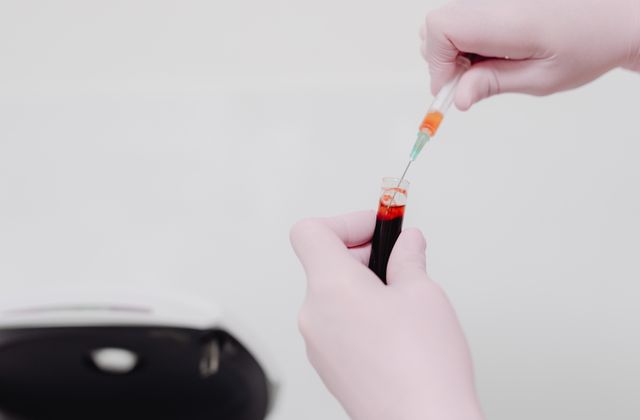
For fluid around the lungs, the procedure is called thoracentesis. You sit upright, leaning slightly forward with your arms resting on a table. The doctor numbs a small patch of skin on your back or side. The numbing injection stings for a few seconds, like any injection, and then the area goes dull. A thin needle goes between the ribs. The classic instruction doctors follow is to slide just above the top edge of the rib, avoiding the nerve and blood vessels that run along the rib's lower edge. Then comes the odd part: not pain, but pressure, and a strange drawing sensation as the fluid flows through a tube into a sterile bottle. Most people say afterwards that the waiting was worse than the thing itself. A small dressing goes on, and you sit back.
For fluid from around the brain and spinal cord, the collection is a lumbar puncture. You lie curled on your side or sit hunched forward. The lower back is numbed, and a thin needle collects a small amount of the clear fluid that bathes the brain and spine. For belly fluid, the doctor numbs a spot on the abdomen and draws the fluid with a needle. For a swollen lymph node, a fine needle aspirate: a very thin needle, often with an ultrasound guiding it, pulls out a few drops of cells and fluid from the node itself.
No fasting is needed for any of this. Eat normally and take your usual medicines unless your doctor has told you otherwise. Blood thinners and the exact spot of the tap are the two things doctors like to know about in advance, so mention them without being asked.
A small practical point that saves a wasted trip: the lab test and the fluid collection are two separate bookings. Your doctor collects the fluid at the clinic or hospital and the sealed container travels to the lab. If you book the lab test first and ask our team, they will tell you exactly what the container needs to look like and how quickly it should reach us. Warm, fresh, and sealed beats a sample that sat around.
The fluid goes into sealed, sterile containers, labelled, and sent to the lab. If you are watching it leave the room, that sealed bottle is the most important thing in the building for the next few hours.
Inside our lab: what happens to the sealed bottle
At our lab in Malad, molecular samples don't join the routine blood-test queue. They go to the molecular section, where the workflow runs in two steps.
First, the in-house RT-PCR screen. (A quick note on the name: Indian labs commonly say "RT-PCR" to mean real-time PCR, the DNA-copying technique. Strictly speaking, RT-PCR stands for reverse-transcription PCR, a related but different method. Same family, same idea of copying genetic material to detectable levels.)
The fluid is processed to crack open any bacteria and release their DNA. Then the run begins, watching cycle by cycle for the TB bacterium's genetic signature. If the signature never appears, the answer is "not detected" and the run ends there.
If it does appear, the same sample moves to the Ultra CBNAAT step, which reads the rpoB gene region for the mutations linked to rifampicin resistance. Bundling this as one reflex order saves days, because knowing about resistance early shapes the treatment discussion from day one.
Molecular testing takes longer than a routine blood report. The sample needs processing time, the machine needs its run time, and the results need review before they go out. When the test is booked, our team confirms the expected reporting time, and the report goes out as soon as the run is complete. Our lab is open 24x7, so samples don't sit waiting for morning.
Reading your report without the 3 a.m. panic
Reports for this test are shorter than people expect, which somehow makes them scarier. There are really two headline lines.
The first is TB detection: detected or not detected. That answers one question only, whether TB DNA was found in that particular fluid sample.
The second line appears only when TB was detected: the rifampicin resistance result. It will say something like resistance detected, not detected, or indeterminate. Resistance detected means the bacteria in your sample carry the genetic change linked to rifampicin resistance, and your doctor uses that to plan the treatment course. Not detected means no resistance signal was found.
"Indeterminate" deserves its own paragraph because it causes the most midnight Googling. It usually means there wasn't quite enough bacterial DNA in the sample to call the resistance question either way. It is not a failed test, and it is not a secret code for something worse. With very low bacterial loads, the newer Ultra cartridges can even give what labs call a "trace" call, the faintest whisper of a signal. Your doctor may ask for a repeat sample, or may read the result alongside your other reports and decide no repeat is needed.
Two things to hold onto while reading. First, reference details and result formats vary by laboratory, so treat your report as evidence, not a verdict. Second, a positive PCR result on its own is not the whole diagnosis.
Your doctor reads it together with your symptoms, your scans or X-ray, and your other test results before anything is decided. That isn't hedging. It's how medicine works when the test measures DNA, not disease.
When the answer is "not detected" and the fever stays
This is the hard section, and it matters more than any other.
A negative PCR result lowers suspicion. It does not fully rule TB out. No single test does, and this one has a measurable miss rate that changes with the fluid being tested.
The honest numbers: in WHO's review of these cartridge tests on extrapulmonary samples, sensitivity ran from about 50 percent in pleural fluid up to 97 percent in synovial (joint) fluid. Newer Ultra cartridges do better in some fluids, around 71 to 75 percent in pleural fluid and up to 100 percent in lymph node biopsy, but the pattern holds. Pleural fluid is simply a hard sample. The bacteria hide in the lining, the fluid carries few of them, and even the best DNA-copying machine can only copy what is actually in the bottle.
So if your report says "not detected" and you still have the evening fever, the weight loss, the effusion on the scan, the conversation with your doctor isn't over. Reasonable next steps include repeating the test on a fresh sample (a bigger volume of fluid, sometimes concentrated in the lab by spinning it down, improves the odds), supporting tests that look at the fluid's chemistry rather than its DNA, and, when suspicion stays high, culture or a tissue biopsy. None of that is your job to order. It is your job to go back to the doctor instead of filing the report away as a clean chit.
The backup team: ADA, culture, biopsy
Because no single test closes the case on body-fluid TB, doctors usually order this PCR as part of a team. It helps to know the teammates by name so the rest of your prescription stops looking like code.
ADA, or adenosine deaminase, is an enzyme made by lymphocytes, the immune cells that flood into TB-infected fluid. A high ADA level in pleural fluid points toward TB, and the most widely used cutoff is 40 units per litre, with studies reporting roughly 92 to 93 percent sensitivity and 90 percent specificity at that line. You can book it as its own test: the ADA test on pleural fluid. ADA isn't TB-specific, very high levels can occasionally point toward lymphoma or other infections, so doctors read it together with the fluid's cell pattern: TB effusions are usually straw-coloured, protein-rich, and packed with lymphocytes, with a fluid pH typically above 7.3.
Culture remains the gold standard: grow the bacteria and you have your answer beyond argument. It detects as few as 10 to 100 bacteria per millilitre. The price of that certainty is time. TB bacteria grow slowly, and cultures can take weeks, in high-security labs built for the purpose. Nobody wants to wait weeks to start treatment, which is exactly why the two-hour PCR exists.
Biopsy looks at the tissue lining itself rather than the fluid. Under the microscope, TB leaves a characteristic signature: granulomas, little organized clusters of immune cells, sometimes with a cheesy-looking dead centre doctors call caseation. In pleural TB, biopsy finds these in roughly half to four-fifths of cases.
Notice what the doctor is doing. The PCR asks "is the DNA here." The ADA and cell pattern ask "does this fluid look like the immune system's response to TB." The biopsy asks "does the tissue show the damage." Three different questions, one diagnosis. When your reports seem to disagree with each other, it is usually because they were asking different questions.
And sometimes the doctor orders the same PCR on a second sample, or on a different fluid from the same patient. That isn't indecision. Studies keep finding that larger fluid volumes, concentrated in the lab by spinning them down, give the test more DNA to work with. A small, dilute sample is simply a harder sample. If you're asked for a repeat tap, the likeliest reason is physics, not doubt.
Two mistakes worth not making with this report
The first mistake is treating "not detected" as an all-clear and cancelling the follow-up. You've read the section above, so you know the miss rate in pleural fluid is real. A negative result on a hard sample with a still-suspicious patient is a pause, not a period.
Doctors see this pattern often: the report says not detected, the fever continues, the patient disappears for three months, and the effusion is twice the size when they return. If your doctor asked you to come back, go back. The report didn't end the story; it just didn't finish the sentence.
The second mistake is the mirror image: reading "detected" as a finished diagnosis and spiralling before the doctor's appointment. TB outside the lungs is treatable, and that includes the drug-resistant forms, which have their own treatment pathways under the national programme. What "detected" actually gives you is a head start. In the old days, the equivalent answer arrived after weeks of culture, and treatment decisions waited with it. Now your doctor can start the planning conversation with the DNA evidence and the rifampicin answer in hand. Between a positive report and your next visit, the most useful thing you can do is boring: keep your scans, previous reports, and prescription in one folder and bring all of it. Doctors diagnose faster with complete paperwork than with a single dramatic report.
There is a third, quieter mistake: delaying the test because the collection sounds frightening. Every week of delay is a week the bacteria spend doing what bacteria do. The numbing injection stings for seconds. The untreated disease doesn't negotiate. If the prescription is sitting in your drawer, book the collection this week.
FAQs
Is this the same as a TB blood test? No. The blood tests people mean by "TB blood test" detect your immune system's memory of TB exposure. They can't tell where the bacteria are, or whether the disease is active. This test looks for the bacterium's actual DNA in a specific fluid sample. Different question, different answer.
Is a positive result the same as a TB diagnosis? Not by itself. It says TB DNA was present in that fluid sample. Your doctor reads that together with your symptoms, scans, and other reports. Also remember that PCR can pick up DNA from bacteria that are no longer alive, so a positive in someone treated for TB in the past needs careful interpretation.
What does "rifampicin resistance detected" mean? It means the bacteria in your sample carry a genetic change in the rpoB gene linked to resistance against rifampicin, a main first-line TB drug. Your doctor uses this result to choose the right treatment course. It doesn't speak to other drugs; that needs separate testing.
What does "indeterminate" mean on the resistance line? Usually, not enough bacterial DNA to call the resistance question either way. It isn't a failed test. Your doctor may request a repeat sample or proceed on the strength of your other reports.
Can this test be done on sputum instead? Yes, if you can produce sputum. There is a separate CBNAAT sputum test for TB detection with rifampicin resistance for lung cases. Your doctor picks the sample type based on where the disease seems to be, not on convenience.
Does a tissue biopsy need a different version of this test? Yes. Tissue and biopsy samples are prepared differently, so they run through AFB DNA detection by real-time PCR on tissue and biopsy instead of the fluid version.
Is this test painful? The laboratory part is painless; your job ends when the bottle leaves the room. The collection involves a numbed patch of skin and a few minutes of pressure, and it's done by a doctor, not at a home visit.
Do I need to fast before the fluid collection? No. Eat normally and take your regular medicines unless your doctor says otherwise. There is nothing about food that changes a DNA test on body fluid.
How long do the results take? Longer than a routine blood report, because the sample needs processing and the machine needs its full run. Our team confirms the expected reporting time when the test is booked, and the report goes out as soon as the run is complete.
Will this test check resistance to other TB drugs too? No. The reflex step checks rifampicin only. Full drug-susceptibility testing, which covers more drugs, is a separate process your doctor can order if the clinical picture calls for it.
Booking this test in Mumbai
Start from our tests page, where the AFB-DNA TB PCR body fluid test sits with its live price. Prescriptions here usually carry a companion: the ZN stain smear on body fluids, cheap and quick, which settles the question instantly when it turns positive. A negative smear is exactly when the PCR earns its keep.
The test also rides inside the Respiratory TB Screening Panel, which wraps TB detection together with related respiratory markers into one booking for cases that are still unclear. Browse all our health packages if your doctor suggested a wider workup.
Book the lab test on 84250 40353; our Malad lab runs 24x7, and the team confirms the exact reporting time for molecular tests at booking. One practical detail to get right: the fluid itself is collected by your doctor at a clinic or hospital, not by a home visit, so line up the lab booking and the collection appointment as a pair.
Takeaways
- This test looks for TB DNA in body fluid, not in sputum and not in blood. Different samples answer different questions.
- PCR is far more sensitive than the smear slide. A negative smear on body fluid never ends the story.
- The reflex Ultra step checks rifampicin resistance automatically from the same sample. No second collection, no second prescription.
- The fluid is collected by a doctor, thoracentesis, tap, lumbar puncture, or fine-needle aspirate, with local anaesthetic. No fasting needed.
- "Detected" or "not detected" on the report is evidence, not the diagnosis. Your doctor reads it with your symptoms, scans, and other tests.
- "Not detected" doesn't fully rule TB out. Sensitivity runs from about 50 percent in pleural fluid to over 90 percent in other fluids, so a repeat sample or supporting tests may follow.
- TB outside the lungs is common, recognizable, and treatable once found. The test exists so that the hiding places stop being hiding places.
References
- WHO consolidated guidelines on tuberculosis, Module 3: Diagnosis (3rd edition). Recommendations on Xpert MTB/RIF and Xpert Ultra for extrapulmonary TB and rifampicin resistance detection.
- WHO Rapid Communication on Xpert MTB/RIF and Xpert Ultra for extrapulmonary TB: sensitivity by specimen type (pleural fluid 50 percent to synovial fluid 97 percent); rifampicin resistance detection sensitivity 96 to 97 percent, specificity 99 percent.
- Kohli et al., Cochrane Database of Systematic Reviews 2021: Xpert MTB/RIF Ultra for extrapulmonary TB and rifampicin resistance in adults.
- AAFP, Extrapulmonary Tuberculosis: An Overview. Tuberculous lymphadenitis as the most common extrapulmonary form; pleural fluid and CSF profiles.
Book these tests at home
Live prices · free home sample collection in Malad, Kandivali, Borivali & Goregaon
Adenosine Deaminase (ADA)(Pleural fluid)
- Report in 24 hrs
- At our Malad West lab
AFB - M.Tb Detection with Rifampicin resistance by CBNAAT Sputum
- Report in 24 hrs
- At our Malad West lab
AFB - detection of DNA by Real time PCR Tissue and biopsy
- Report in 96 hrs
- At our Malad West lab
AFB - DNA (TB - PCR) Detection by RTPCR, Reflex to Rifampicin resistance by Ultra CBNAAT (Body Fluid)
- Report in 48 hrs
- At our Malad West lab
AFB - detection by smear examination ZN Stain Body fluids
- Report in 24 hrs
- At our Malad West lab
More tests related to this topic
Other Pathology tests you can book with free home sample collection.
17p Deletion p53 (MM, CLL), Heparin Bone Marrow
- Report in 24 hrs
- At our Malad West lab
24 Hours Urinary Phosphorous
- Report in 24 hrs
- Free home collection
5 - Hydroxy Indole Acetic Acid (5 - HIAA) - URINE
- Report in 24 hrs
- Free home collection
5q Deletion/Monosomy (MDS), Heparin Bone Marrow
- Report in 24 hrs
- At our Malad West lab
7q Deletion/Monosomy (MDS), Heparin Bone Marrow
- Report in 24 hrs
- At our Malad West lab
ABO Blood Group and Rh Type
- Report in 12 hrs
- Free home collection
Acetyl Choline Receptor Antibodies (AChRab)
- Report in 24 hrs
- Free home collection
Acid Fast Bacilli Smear
- Report in 24 hrs
- Free home collection
ACID PHOSPHATASE
- Report in 24 hrs
- Free home collection
Acid Phosphatase Total and prostatic fraction Serum
- Report in 24 hrs
- Free home collection
Adenosine Deaminase (ADA - Synovial Fluid)
- Report in 24 hrs
- At our Malad West lab
Adenosine Deaminase (ADA)
- Report in 24 hrs
- Free home collection
Get more from the same visit
Health packages that already include these tests, and tests people usually add.
Frequently asked questions
Is this the same as a TB blood test?
No. TB blood tests detect your immune system's memory of TB exposure and cannot tell where the bacteria are or whether disease is active. This test looks for the bacterium's actual DNA in a specific fluid sample, such as fluid from around the lungs, the abdomen, or a lymph node.
Is a positive result the same as a TB diagnosis?
Not by itself. It says TB DNA was present in that fluid sample. Your doctor reads it together with your symptoms, scans or X-ray, and other reports before deciding anything. PCR can also pick up DNA from bacteria that are no longer alive, which needs careful interpretation in someone treated for TB in the past.
What does rifampicin resistance detected mean?
It means the bacteria in your sample carry a genetic change in the rpoB gene linked to resistance against rifampicin, one of the main first-line TB drugs. Your doctor uses this result to choose the right treatment course. It does not speak to other drugs; that needs separate testing.
What does indeterminate mean on the resistance line?
Usually it means there was not quite enough bacterial DNA in the sample to call the resistance question either way. It is not a failed test. Your doctor may ask for a repeat sample or proceed on the strength of your other reports.
Can this test be done on sputum instead?
Yes, if you can produce sputum. There is a separate CBNAAT sputum test for TB detection with rifampicin resistance for lung cases. Your doctor picks the sample type based on where the disease seems to be, not on convenience.
Does a tissue biopsy need a different version of this test?
Yes. Tissue and biopsy samples are prepared differently, so they run through the AFB DNA detection by real-time PCR on tissue and biopsy version instead of the fluid version.
Is this test painful?
The laboratory part is painless. The collection involves a numbed patch of skin and a few minutes of pressure, and it is done by a doctor at a clinic or hospital, not at a home visit.
Do I need to fast before the fluid collection?
No. Eat normally and take your regular medicines unless your doctor says otherwise. There is nothing about food that changes a DNA test on body fluid.
How long do the results take?
Longer than a routine blood report, because the sample needs processing and the machine needs its full run, followed by review. The lab confirms the expected reporting time when the test is booked, and the report goes out as soon as the run is complete.
Will this test check resistance to other TB drugs too?
No. The reflex step checks rifampicin only. Full drug-susceptibility testing, which covers more drugs, is a separate process your doctor can order if the clinical picture calls for it.
HWP Diagnostic Editorial Team
Health guides written by the team at HWP Diagnostic, Mumbai, to help you understand your tests before you book. This article is for general education and is not a substitute for medical advice - reference ranges vary between labs, so always discuss your results with your doctor. Read our editorial policy. Photos: Pexels.