
Key takeaways
- This test measures your allergy antibody (IgE) against Aspergillus fumigatus, not an infection.
- No fasting or special preparation is needed; one venous blood draw, reports in about 24 hours.
- Classes 0 to 6 show antibody strength, not symptom severity; the doctor reads the number with your history.
- Class 1 and the 0.10 to 0.34 band are borderline or equivocal; class 2 and above is where labs flag a positive.
- In asthma care a positive result can point the doctor toward checking for allergic bronchopulmonary aspergillosis; the galactomannan antigen test is the one used for suspected invasive infection.
- It pairs naturally with the Allergy Panel - Inhalant or the Allergy Combo Package when the doctor is checking multiple triggers.
Book tests from this article
Sample collected at home - free
- Allergen, Individual - Micro organism Aspergillus Fumigatus fungus
₹1,849₹2,49926% off
- Galactomannan, Aspergillus Antigen test by EIA - Serum
₹7,399₹8,64914% off
- Allergy Panel - Inhalant
₹3,499₹6,39945% off
Free collection 24 hr reports
Your doctor wrote a mould's name on your slip. Here is why.
The five-syllable Latin name on this slip, Aspergillus fumigatus, is what makes people google in the waiting room. It sounds like an infection. The test it names is an allergy test, and it answers a narrower question than the name suggests: does your immune system make IgE antibodies against one particular airborne mould?
That is all it does. One small tube of blood, no fasting, no preparation, and the report usually lands within about 24 hours. What it does not do is test for a fungal infection. That is a separate blood test entirely, and the two get confused so often that the confusion deserves its own section below.
At our lab in Malad, this test tends to arrive after the obvious suspects have been ruled out. The dusting has been done. The pillow covers have been changed. The cough syrups helped for a day and then stopped. The sneezing runs through the whole school term, or there is a "cold" that never quite leaves, or the asthma plan is in place but something keeps flaring it. So the doctor writes down a mould's name, and you end up here, reading this.

Allergy or infection? The split that matters before anything else
This is the single most important section of this article, so let us get it out of the way first. An allergy to Aspergillus and an Aspergillus infection are two completely different medical situations, diagnosed with completely different blood tests.
The allergy version is what your slip is about. Your immune system meets mould spores in the air, decides they are dangerous, and makes allergy antibodies (IgE) against them. You are healthy in every other respect. Your lungs work fine. You just sneeze, wheeze, or get itchy eyes more than the next person when spores drift past.
The infection version is rare and belongs to a different world. Invasive aspergillosis happens almost entirely in people whose immune defences are seriously weakened: patients on chemotherapy, organ transplant recipients on immunosuppressive drugs, people with prolonged neutropenia, or those on long courses of high-dose steroids. That is the CDC's own framing of the disease, and it is why the CDC lists the galactomannan antigen test among the diagnostic tools for it. Galactomannan is a polysaccharide that makes up part of the Aspergillus cell wall, and the test detects it in serum or in fluid washed from the lungs (bronchoalveolar lavage). The US FDA has cleared the Platelia assay for exactly this use. A positive galactomannan result supports a diagnosis of invasive fungal disease. Your allergen IgE test cannot do that job, and it was never meant to.
So when your report comes back for the test you are actually getting, the Aspergillus fumigatus allergen test, read it as an answer to one question only: does my immune system make allergy antibodies against this mould? Nothing more. If a doctor ever suspects the infection version instead, they will order the galactomannan Aspergillus antigen test on a separate slip. Different question, different blood test, different answer.
One more thing worth knowing while we are drawing lines: a positive allergy result does not mean spores are growing inside you. Sensitisation means your immune system has learned to react to the spores. It does not mean you have a fungal colony anywhere. Plenty of people with a positive Aspergillus IgE have perfectly clear lungs.
Meet the actual mould, a Mumbai monsoon resident
Aspergillus fumigatus is, scientifically speaking, unremarkable. It lives in soil, on rotting leaves and plant litter, in decaying vegetables, in compost heaps, and in bird droppings, according to an NHS patient leaflet on mould allergy. Its spores float in ordinary air, indoors and outdoors. Compared with some other moulds, its airborne spore concentration is actually relatively low. You have been breathing these spores in and out your whole life, and so has everyone around you.
What makes it matter in Mumbai is our weather. Mould loves damp, musty conditions, and this city hands it both for months at a stretch. The monsoon soaks walls that take weeks to dry. Window AC vents that have not been cleaned since last summer collect dust and moisture behind the grille. Pigeon droppings gather on window ledges and balcony parapets. A compost pit behind the building society keeps things nicely warm and wet. None of this is a crisis, and none of it means your home is dirty. It just means Mumbai gives mould more places to settle than a drier city would.
When spores get into your nose and eyes, they can trigger the classic set: sneezing, congestion, a runny or itchy nose, itchy or watery eyes, coughing, postnasal drip, and in some people itchy skin or a rash. Mould allergy is nonseasonal, unlike most pollen allergy, so symptoms can run all year. They tend to flare in damp, humid rooms (bathrooms, basements, garages) and when spore counts peak, which an Anaphylaxis UK factsheet places in late summer and autumn.
One neat detail from that same factsheet: spores get released in bursts when the temperature in a damp environment rises quickly, like when heating gets switched on in a damp house. In Mumbai the equivalent is the AC kicking on after a humid afternoon, or the first blast of a ceiling fan in a room that has been shut all day.
For people with asthma, the stakes are a notch higher. Inhaled spores can reach the lower airways and trigger coughing, wheezing, and shortness of breath. That is the precise reason this test shows up so often on asthma patients' slips, and we will come back to that in the asthma section.
What the blood draw really involves
Nothing about this test requires you to suffer for it. No fasting. No avoiding dust or damp rooms beforehand. No stopping at the pharmacy for anything. Eat your breakfast, drink your chai, and show up as you are.
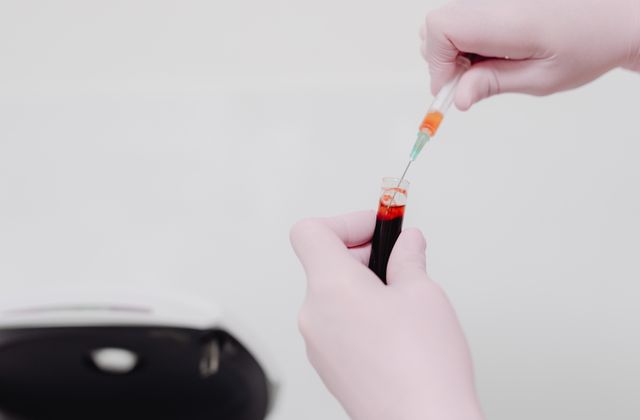
The phlebotomist ties the tourniquet band around your upper arm, taps the inside of your elbow to raise a vein, and the needle prick is one sharp pinch that is over in about two seconds. The tube fills while you breathe normally. The band comes off, a cotton ball gets pressed into the crook of your elbow and taped down. Keep it there for about twenty minutes and skip the heavy lifting with that arm for the rest of the day.
For home collection, which is free across Malad, Kandivali, Borivali and Goregaon, the routine is the same at your doorstep. The phlebotomist carries the kit in, finds a well-lit chair, and is usually done within five minutes. Parents generally keep small children on their laps so the pinch lands mid-sentence, and honestly, most kids are back to their phones before the cotton is taped.
At the counter, one question comes up almost every day with this particular slip: "Is this the TB test?" The name is confusing, and there is no shame in asking. It is not. It is an allergy blood test, full stop. The other frequent one: "Do I need to come on an empty stomach?" No. Allergy IgE testing does not need fasting, and the level does not swing with your last meal the way sugar or triglycerides do.
What you should bring: the doctor's prescription slip (so the front desk matches the exact test), and a list of every medicine you take. Mention antihistamines, asthma inhalers, steroid nasal sprays, everything. Your doctor decides whether anything needs pausing before the draw. Do not stop any medicine on your own based on something you read online. The test measures antibodies that are already in your blood, but your doctor still wants the full picture.
How the lab turns a tube of blood into a class
Your tube takes a short journey you never see. The blood is spun in a centrifuge so the clear serum separates from the cells. That serum is what gets tested. The method most labs use for this is a fluorescence enzyme immunoassay, the family of tests sold under names like ImmunoCAP, and it works on a beautifully simple idea.
Inside the analyser, tiny solid-phase surfaces are coated with Aspergillus fumigatus allergen proteins. Your serum washes over them. If your blood carries IgE antibodies shaped to fit those proteins, they stick. Everything else gets washed away. Then a second antibody, tagged with a fluorescent label, is added. It latches onto any captured IgE and lights up. The machine reads the brightness of that glow and converts it into a number: kilo-units of allergen-specific IgE per litre, written kU/L or kUA/L.
That is the whole magic trick. No spores are put into your body. No skin gets scratched. The reaction happens in a cartridge, and your arm never knows.
A few lab-side details are worth knowing because they explain quirks on reports. Serum keeps well: refrigerated samples stay good for about two weeks, frozen for months, so a tube drawn at your home in Borivali reaches the analyser in perfect shape. The test needs only a small amount of serum, which is why one draw can feed several allergen tests at once. And because the method detects antibodies already circulating in your blood, it works even in people who could not safely do a skin prick test, like those with severe eczema or a history of strong reactions.
There is one known trap in the method, and honest labs will tell you about it. When a person's total IgE is extremely high, above about 2500 kU/L, the excess antibodies can stick nonspecifically to the test surfaces and produce a falsely positive-looking result. Mayo Clinic Laboratories' own test catalogues flag this. It is one more reason your doctor reads this number alongside your total IgE and your history, never alone.
The 0-to-6 ladder on your report, decoded
Your report shows two things: a number in kU/L and a class from 0 to 6. The class is just a bucket the number falls into, and labs across the world use nearly identical buckets. Here is the ladder as published in Mayo Clinic Laboratories' test catalogues, which match what most Indian labs print:
- Class 0, below 0.10 kU/L: Negative. No significant level of this allergy antibody detected.
- Class 0/1, 0.10 to 0.34 kU/L: Borderline or equivocal. The clinical relevance of this band is officially undetermined, and Mayo's catalogues say these low-level results are intended for specialist interpretation.
- Class 1, 0.35 to 0.69 kU/L: Equivocal to low. Antibody present at a low level. Your doctor may repeat the test later or simply watch your symptoms.
- Class 2, 0.70 to 3.49 kU/L: Positive, moderate. This is the band where laboratories start flagging the result as abnormally high.
- Class 3, 3.50 to 17.4 kU/L: Positive, high.
- Class 4, 17.5 to 49.9 kU/L: Strongly positive.
- Class 5, 50.0 to 99.9 kU/L: Strongly positive, very high.
- Class 6, 100 kU/L and above: Strongly positive, extremely high.
Two caveats, and both matter. First, these buckets describe antibody strength, not how miserable you feel. A class 5 does not mean five times the sneezing of a class 1. It means your blood carries a lot of this particular antibody. Your doctor maps that onto your symptoms, your exposures, and your other test results before drawing any conclusion.
Second, ranges vary by laboratory. The exact cutoffs above come from one lab's catalogue. Your lab's printed reference range is the one that governs your report. Compare your number only against the range printed on your own report, never against a table from the internet. If sources disagree on a cutoff, the lab that ran your sample wins the argument.
One more decoding note for the number itself. The units kU/L and kUA/L mean the same thing in practice, and a value like 2.4 kU/L is not "2.4 times normal". There is no normal. There is just the ladder above, and your rung on it.
When the number and your symptoms disagree
This happens more often than patients expect, and it is completely normal. The relationship between antibody level and real-life suffering is loose, and the lab catalogues say so outright: IgE levels may not correlate with clinical response, and a negative test may not rule out a clinical allergy.
Consider the mismatches we see:
- High class, mild symptoms. Your blood carries a strong antibody signal, but you sneeze a little in dusty rooms and otherwise get on with life. This is sensitisation without much disease. The antibody is real. The suffering is not. Your doctor may simply note it and move on, or use it to explain why a particular season bothers you.
- Low class, strong symptoms. You are miserable for weeks, but the report says class 1 or even 0. Several things can explain this. Your main trigger might be a different mould or a dust mite, and Aspergillus was simply the wrong suspect. Your symptoms might be non-allergic rhinitis, which mimics allergy without the IgE. Or your sensitisation might be real but below what this blood method picks up on the day you were tested. Antibody levels can drift down with time away from exposure.
- Borderline class 1, and nobody is sure. This is the grey zone the catalogues describe as equivocal. Some doctors repeat the test after a few months. Some correlate it with a skin prick test. Some treat the patient, not the number, and see whether targeted avoidance or treatment helps.
There is also the reverse trap: a positive result to a mould you have never reacted to. Blood tests detect sensitisation, which is an immune memory. Immune memories do not always translate into symptoms. This is why allergists keep repeating the same sentence in every guideline: interpret the result in the clinical context. The history, the examination, and sometimes a skin test complete the picture that blood alone cannot.
If your result surprised you, the right move is not to re-Google the number. It is to take the report back to the doctor who ordered it and ask what they make of it in light of your story. That conversation is where the number becomes a diagnosis, or gets filed away as a red herring.
Why this test shows up in asthma care
Here is where the Aspergillus IgE test earns its keep beyond simple sneezing. Mould sensitisation and asthma travel together more often than most people realise, and doctors use this test as a scout for a few specific situations.
Fungal sensitisation in asthma. A 2023 meta-analysis by Agarwal and colleagues, summarised in a 2025 EAACI task force report, put the prevalence of Aspergillus sensitisation in people with asthma at about 25 percent, roughly one in four. An Indian study by Prasad and colleagues found 30.3 percent among 244 patients with bronchial asthma. The task force also notes that fungal sensitisation runs at least three times higher in people with asthma than in the general population. This does not mean a quarter of asthmatics need this test. It means that when asthma is hard to control, checking for a fungal trigger is a reasonable next step, and this blood test is how that check is done.
Severe asthma with fungal sensitisation (SAFS). This is a label doctors use for people with severe asthma who show IgE sensitisation to fungi but do not meet the criteria for the condition below. It matters because it changes how the doctor thinks about the case, not because it changes what you do at home.
Allergic bronchopulmonary aspergillosis (ABPA). This is the condition your doctor is quietly screening for when they order Aspergillus IgE in someone with asthma or bronchiectasis. In ABPA, the immune system overreacts so strongly to Aspergillus in the airways that it causes lung inflammation, mucus plugging, and over time, damage to the airways. It is an allergy, not an infection, but a much more serious one than hay fever.
The diagnostic criteria were revised in 2024 by the ISHAM-ABPA working group and published in the European Respiratory Journal. They require a predisposing condition (asthma, cystic fibrosis, COPD, or bronchiectasis) or a compatible clinical picture, plus two essential components: Aspergillus-specific IgE of at least 0.35 kUA/L (that is class 1 and above on your report's ladder) and total serum IgE of at least 500 IU/mL, plus any two of three other findings: positive Aspergillus IgG, blood eosinophils at or above 500 cells per microlitre, or characteristic CT findings like bronchiectasis, mucus plugging, or high-attenuation mucus. High-attenuation mucus on CT is considered so characteristic that it can confirm the diagnosis nearly on its own.
Notice what that means for your report. A positive Aspergillus IgE is one piece of the ABPA puzzle, never the whole thing. If your doctor ordered only the specific IgE and it came back positive, the usual next steps are a total IgE level, a blood eosinophil count, and a conversation about whether your asthma pattern fits. Do not try to self-diagnose ABPA from a single IgE number. The criteria exist precisely because one number is never enough.
There is a practical Mumbai angle here too. ABPA is not rare in Indian asthma clinics, and studies from Indian centres have contributed heavily to the global literature on it. If you have asthma that stays uncontrolled despite regular treatment, brownish mucus plugs when you cough, or repeated chest shadows on X-rays that come and go, these are the textbook flags doctors look for. Mention them at your appointment rather than waiting to be asked.
The questions that pile up at our counter
Do I need to fast for this test? No. Eat normally. Allergy antibody levels do not swing with meals, and no guideline or lab asks you to fast for a specific-IgE draw.
Should I stop my allergy medicines before the draw? Tell your doctor and the phlebotomist about every medicine you take, including antihistamines, inhalers, and steroid nasal sprays. Your doctor decides whether anything needs pausing. Do not stop anything on your own. One advantage of the blood test over a skin prick test is that antihistamines do not ruin it the way they can blunt a skin test wheal.
Does a positive result mean I have a fungal infection? No. This test looks for the allergy antibody only and says nothing about infection. The infection test is the galactomannan antigen test, ordered separately, and mostly used in severely immunocompromised patients.
My class is 1. Does that mean I am allergic? Class 1 is a low, borderline-to-equivocal reading. It means a small amount of antibody was detected. Some doctors repeat the test after a few months, some correlate it with your symptoms or a skin test, and some simply watch. Your doctor decides, not the number alone.
My class is 5 but I barely sneeze. Is the test wrong? Probably not wrong, just answering a narrower question than you think. A high class means strong sensitisation. It does not guarantee strong symptoms. Plenty of people carry high specific IgE to things they barely react to.
My class is 0 but my symptoms continue. Now what? A negative Aspergillus result rules out Aspergillus sensitisation, not allergy in general. Your trigger may be a dust mite, a different mould, or pollen, which is exactly when doctors order the broader Allergy Panel - Inhalant. Non-allergic rhinitis can also mimic allergy symptoms without any IgE at all. Take the report back and discuss the next suspect.
Can this test tell which asthma treatment I need? No. It is one clue, not a treatment plan. In asthma care it helps the doctor decide whether a fungal trigger or ABPA belongs on the differential. Treatment decisions come from the full clinical picture.
How is this different from a skin prick test? A skin prick test puts a tiny amount of allergen on your forearm and watches for a raised wheal. It is quick and cheap, but antihistamines interfere with it, and it cannot be done on widespread eczema. The blood test measures the antibody directly, works regardless of skin condition or antihistamines, and gives you a number you can track over time. Doctors often use them as complements, not competitors.
How long until I get the report? Usually about 24 hours. The report arrives as a PDF you can forward straight to your doctor on WhatsApp.
Will I need to repeat this test? Sometimes. A borderline class 1 may get repeated after a few months to see which way it moves. In ABPA follow-up, doctors track total IgE over time rather than repeating the specific IgE endlessly. If your symptoms change character, your doctor may re-test or broaden the panel.
Booking, home collection, and the panels that wrap this test
You can book this test on its own through the Aspergillus fumigatus allergen test page, where you will also see the current price and sample details.
In practice, though, this test rarely travels alone. Mould allergy seldom exists in a vacuum, and doctors usually want the wider picture of your inhalant triggers. That is where the panels come in.
The natural parent panel is the Allergy Panel - Inhalant. It checks a whole set of dust, pollen, and mould sensitivities in a single draw, so instead of ordering allergens one by one, your doctor gets the full inhalant picture at once. If your Aspergillus IgE came back as part of a hunt for "why do I keep sneezing," this panel is usually what the doctor reaches for next, or what they should have ordered first.
For a wider net, the Allergy Combo Package wraps broader allergy screening into a single booking. Think of it as the difference between checking one suspect and running the full lineup. Your doctor will tell you which level of workup your story needs.
Two practical notes. First, if your report shows sensitisation to several things at once, that is normal and not a cause for alarm. Atopic people collect sensitisations the way frequent flyers collect stamps. The doctor's job is to figure out which ones actually drive your symptoms. Second, if you are new to single-allergen blood tests, our earlier piece on the egg white allergy test walks through how the same IgE machinery works for a completely different trigger. The classes, the method, and the caveats are the same; only the allergen changes.
Booking is straightforward. If you would rather not travel, 84250 40353 gets a phlebotomist to your doorstep; collection is free across Malad, Kandivali, Borivali and Goregaon and takes about five minutes in a well-lit chair. The lab itself runs 24x7, so a late-night walk-in works too, and the report is usually back within about 24 hours. If you are still browsing, the tests page lists everything the lab runs.
Dos and don'ts for test day
Do:
- Do book at any time of day. Antibody levels do not follow a daily rhythm worth chasing.
- Do eat and drink normally before the draw.
- Do bring your prescription slip so the front desk books the exact test your doctor ordered.
- Do list every medicine you take, including inhalers and nasal sprays, and let your doctor decide about pausing anything.
- Do drink some water beforehand. It makes veins easier to find, especially at a home visit.
- Do keep the cotton ball taped on for about twenty minutes and avoid heavy lifting with that arm for the day.
- Do ask the phlebotomist or the counter staff anything that confuses you, including "is this the TB test?" We hear it daily.
Don't:
- Don't fast. There is no benefit and a hungry wait helps nobody.
- Don't stop any medicine on your own before the test.
- Don't scrub or scratch the skin before the draw. Clean is enough.
- Don't panic over a class 1 or a borderline band. Equivocal means equivocal, and your doctor has seen hundreds of them.
- Don't read a high class as a severity score for your symptoms. It measures antibody, not suffering.
- Don't assume a positive result means infection, or that you need antifungal treatment. Allergy and infection are different diseases with different tests.
- Don't compare your number against a random table online. Read it against the reference range printed on your own report.
References
- Mayo Clinic Laboratories, test catalog: Aspergillus fumigatus IgE, Serum (specific-IgE class cutoffs and interpretive comments)
- Agarwal R et al., revised ISHAM-ABPA working group clinical practice guidelines, European Respiratory Journal, 2024 (ABPA diagnostic criteria)
- CDC, Clinical Overview of Aspergillosis (galactomannan antigen test, invasive disease in immunocompromised hosts)
- EAACI Task Force Report, Allergy journal, 2025 (fungal sensitisation prevalence in asthma, SAFS)
Book these tests at home
Live prices · free home sample collection in Malad, Kandivali, Borivali & Goregaon
Allergen, Individual - Micro organism Aspergillus Fumigatus fungus
- Report in 24 hrs
- Free home collection
Galactomannan, Aspergillus Antigen test by EIA - Serum
- Report in 24 hrs
- Free home collection
Allergy Panel - Inhalant
- Report in 48 hrs
- Free home collection
More tests related to this topic
Other Allergy tests you can book with free home sample collection.
ABPA Profile - Allergic Bronchopulmonary Aspergillosis
- Report in 48 hrs
- Free home collection
Allergen, Individual - Food Egg White Anda
- Report in 24 hrs
- Free home collection
Allergen, Individual - Food Egg Yolk Anda
- Report in 24 hrs
- Free home collection
Allergy - Dust Panel (BY IMMUNO - EIA)
- Report in 48 hrs
- Free home collection
Allergy - Milk & Milk Product Panel
- Report in 48 hrs
- Free home collection
Allergy - Non - vegetarian Panel (BY IMMUNO - EIA)
- Report in 48 hrs
- Free home collection
Allergy Panel - Food (Veg & Non-Veg)
- Report in 48 hrs
- Free home collection
Allergy panel - food Vegetarians Panel (BY IMMUNO - EIA)
- Report in 48 hrs
- Free home collection
Allergy panel - others Adult (Comprehensive) Panel parameters (BY IMMUNO - EIA)
- Report in 48 hrs
- Free home collection
Allergy Screening Panel - Total IgE Antibodies with Phadiatop (Above 5 Years)
- Report in 48 hrs
- Free home collection
Allergy Screening Panel - Total IgE Antibodies with Phadiatop (Below 5 Years)
- Report in 48 hrs
- Free home collection
Allergy screening Tryptase
- Report in 48 hrs
- Free home collection
Get more from the same visit
Health packages that already include these tests, and tests people usually add.
Frequently asked questions
Do I need to fast for this test?
No. Eat normally. Allergy antibody levels do not swing with meals, and no lab asks you to fast for a specific-IgE draw.
Should I stop my allergy medicines before the draw?
Tell your doctor and the phlebotomist about every medicine you take. Your doctor decides whether anything needs pausing; never stop anything on your own.
Does a positive result mean I have a fungal infection?
No. This test looks for the allergy antibody only and says nothing about infection. The galactomannan antigen test is the infection test, ordered separately.
My class is 1. Does that mean I am allergic?
Class 1 is a low, borderline-to-equivocal reading. Some doctors repeat the test later, some watch your symptoms. Your doctor decides, not the number alone.
My class is 5 but I barely sneeze. Is the test wrong?
Probably not wrong. A high class means strong sensitisation, which does not guarantee strong symptoms. The test answers a narrower question than you think.
My class is 0 but my symptoms continue. Now what?
A negative Aspergillus result rules out Aspergillus sensitisation, not allergy in general. Your trigger may be a different mould, dust mite, or pollen, which is when doctors order the broader Allergy Panel - Inhalant.
Can this test tell which asthma treatment I need?
No. It is one clue, not a treatment plan. It helps the doctor decide whether a fungal trigger or ABPA belongs on the differential.
How is this different from a skin prick test?
The blood test measures the antibody directly and works regardless of skin condition or antihistamines; the skin test watches for a wheal on your forearm and antihistamines can blunt it. Doctors often use them as complements.
How long until I get the report?
Usually about 24 hours, delivered as a PDF you can forward straight to your doctor.
Will I need to repeat this test?
Sometimes. A borderline class 1 may be repeated after a few months, and in ABPA follow-up doctors track total IgE over time.
HWP Diagnostic Editorial Team
Health guides written by the team at HWP Diagnostic, Mumbai, to help you understand your tests before you book. This article is for general education and is not a substitute for medical advice - reference ranges vary between labs, so always discuss your results with your doctor. Read our editorial policy. Photos: Pexels.