
Key takeaways
- Beta hCG is the pregnancy hormone, and the blood test gives your doctor an exact number in mIU/mL, not just a yes or no.
- Blood detects the hormone earlier than urine strips, usually around the missed period and sometimes a few days before.
- One number is a snapshot. The 48-hour repeat, showing the trend, is where the real information lives.
- Levels vary enormously between healthy pregnancies, and ranges differ by lab, so never compare your number across labs or against a stranger's chart.
- IVF trigger shots contain hCG itself and can confuse the test for up to about two weeks; tell your doctor about any fertility medication.
- No fasting needed, one tube, ten minutes. Free home collection across Malad, Kandivali, Borivali and Goregaon, reports in about a day.
Book tests from this article
Sample collected at home - free
- Beta HCG
₹849₹1,14926% off
- Urine Pregnancy test
₹249₹34929% off
- Thyroid Profile (T3, T4, TSH)
₹699₹1,44952% off
Free collection 24 hr reports
The number that settled it
You have missed your period, and the strip from the chemist shows two pink lines. Or maybe one strong line and one so faint you are holding the thing up to the bathroom light, arguing with it. This is usually the moment the doctor scribbles "Beta HCG" on the prescription pad, and the test that settles the argument is the Beta HCG test.
Strip tests answer a single question: is the hormone there, yes or no? The blood test answers two: is it there, and exactly how much? That second answer, printed as a number, is what your doctor actually works with.
hCG stands for human chorionic gonadotropin. It is a hormone your body only starts making after a fertilised egg implants in the uterus, produced first by the cells that will go on to become the placenta. No pregnancy, no hCG. That is what makes it such a clean signal.
The "beta" in the name is the part that matters. The lab measures the beta subunit of the hormone, the piece unique to pregnancy. That specificity is why the blood test can pick up the hormone earlier and measure it more precisely than anything else.
The report gives an exact value in mIU/mL, milli-international units per millilitre, which is simply the lab's way of counting how many units of the hormone sit in each millilitre of your blood.
No special preparation is needed for this test. That is not a marketing line; it is what the standard medical references say. You eat normally, drink water, and give a small blood sample whenever suits you.

What the hormone is doing inside you
Understanding the number gets much easier once you know what the hormone is actually for. It is not decoration. In the first days after implantation, the tiny cluster of cells that will become the placenta starts releasing hCG into your bloodstream, and the hormone has a job: it tells the corpus luteum, the temporary structure left behind in the ovary after ovulation, to keep producing progesterone.
Progesterone is the hormone that keeps the uterine lining thick and stable, the lining the embryo is settling into. Without the hCG signal, the corpus luteum would wind down, progesterone would drop, and the lining would shed as a period. hCG essentially tells your body to hold position: a pregnancy has started, do not reset.
As the weeks pass, the growing placenta takes over progesterone production for itself, and hCG's early job is done. That is one reason hCG climbs steeply in the first weeks and then eases off. The hormone also nudges your body to make estrogen, which helps prepare for later stages of pregnancy, and it is the signal that stops your periods. It is also, incidentally, the reason many women feel nauseous in those early weeks: the same hormone driving the whole setup is widely thought to contribute to morning sickness.
So when your report shows a number, you are not looking at a random marker. You are looking at a direct readout of how vigorously the early placenta is signalling. That is why doctors care about it, and also why a single number, on its own, is only ever part of the story.
Strip vs blood: why doctors bother with the needle
Home strips detect the same hormone, and the good ones are impressively accurate when used correctly, close to 99% if you follow the instructions. They are cheap, private, and give you an answer in minutes. So why would anyone pay for a blood draw?
Sensitivity is the short answer. A strip needs a fair amount of hCG in your urine before it will change colour. The blood test has no such threshold problem. It can find very small amounts of the hormone, which is why it can usually confirm pregnancy earlier than urine, around the time of your missed period and sometimes a few days before.
Then there is the kind of answer. A strip says pregnant or not pregnant. The blood test says pregnant, and here is the level, and your doctor watches that level move over days. One number is a snapshot; two numbers are a trend. When a doctor is trying to tell whether an early pregnancy is developing normally, or whether something needs a closer look, a yes/no answer is not enough information. That is the whole reason the blood version exists.
There is also the grey zone that strips create and blood resolves. A faint line, an evaporation line that appears after the reading window, a strip read two minutes too late: these are the classic strip anxieties, and they send a lot of people to the lab the next morning. The blood test skips all of that. It does not depend on how concentrated your urine is, what time of day you test, or whether you read it at minute three or minute thirteen.
If you want a middle ground, the lab also offers a lab-grade urine pregnancy test: still a yes-or-no answer, but done under controlled conditions with fresh reagents instead of a strip that sat in your bathroom drawer through a Mumbai summer.
One honest caveat, straight from the Mayo Clinic's guidance: for routine pregnancy confirmation, blood tests are not the default everywhere. Urine tests are cheaper, very accurate, and quicker, while a blood draw can take hours to more than a day for results.
The blood test earns its place when your doctor needs the number itself, or when the strip has left you with more questions than answers.
When to actually get it done
"How soon can I do it?" is the question we hear at the counter most often, usually asked with some urgency. The honest answer has two parts: what the test can do, and what you should do.
What the test can do: blood can usually detect hCG around the time of your missed period, sometimes a few days before. The hormone becomes detectable in blood as early as about 10 days after conception, and it is reliably present by the time a period is due. So yes, the technology allows early testing.
What you should do: wait for the missed period if you possibly can. Here is why. Testing very early can give you a low-but-rising number that your doctor cannot interpret yet, and you spend the next week in a spiral of searching. One clean answer beats two anxious ones. The Mayo Clinic's guidance lands in the same place: home test results are more likely to be accurate after the first day of a missed period, and the same logic applies to blood, because the hormone simply needs time to build.
There is another wrinkle most articles skip: your ovulation does not run on a timetable. Ovulation can shift by days from one month to the next, and the fertilised egg can implant at different times. Both change when hCG starts being made and when any test can find it. So "ten days after conception" is a lab fact that means very little when you are not sure which day conception happened. If your cycles are irregular, the missed period itself becomes a moving target, and your doctor may suggest testing based on your longest usual cycle instead.
One special case deserves its own paragraph, because it catches people every single week. If you are going through IVF or any fertility treatment that used an hCG trigger shot to mature the eggs, that shot IS hCG, the same hormone the test detects. It stays detectable in your blood for up to about 14 days after the injection, fading with a half-life of roughly two and a half days. A blood test taken inside that window can pick up leftover medication instead of a real pregnancy signal, giving you a number that means nothing. Fertility clinics know this and schedule the definitive blood draw about 10 to 14 days after the trigger. If you are tempted to test early at home after a trigger shot, the blood test will not save you from the confusion; it will measure the same leftover hormone. Follow your clinic's schedule.
What the report page looks like
Reports are less mysterious than they look. Your hCG report will have a few lines: the test name (something like "Beta HCG, Quantitative, Serum"), your value in mIU/mL, and a reference range printed alongside it. That range is the lab's own, built from the assay and population its machines are calibrated on. Read your number against the range printed on YOUR report, because ranges differ from one laboratory to another. Two labs can report slightly different numbers on the same blood sample and both be right.
The one cutoff worth knowing: for women who are not pregnant, the usual reference is under 5 mIU/mL. Below that, the test is effectively negative. For men, the reference sits even lower, under 2. Anything clearly above 5 in a woman of reproductive age is a positive that your doctor will interpret in context.
Here is the part that trips people up. Because the number varies so enormously between healthy pregnancies, a single value tells you surprisingly little about how far along you are or how things are going. Two women at the same week can have numbers hundreds or thousands apart and both be perfectly fine. The trajectory of the hormone also changes shape over time: it climbs steeply in the first weeks, roughly doubling every couple of days early on, reaches its peak somewhere around weeks 8 to 11, and then gradually declines for the rest of the pregnancy. That shape matters for reading a report. A number that is still climbing at week five is doing its job. A number that is gently falling at week ten can also be doing its job, because the peak has passed. Without knowing which part of the curve you are on, the number is just a number, which is exactly why doctors pair it with dates and, later, with ultrasound.
One more practical note. If you ever repeat this test at a different lab, do not line the two numbers up side by side and panic about a difference. Assays are not interchangeable between manufacturers, and each lab's reference range reflects its own method. Trends should be tracked on the same lab's reports.
Why one number is never the whole story
Doctors almost never act on a single hCG value. They act on the change between two values, usually drawn about 48 hours apart. This is the single most important thing to understand about this test, so it is worth spelling out plainly.
In early pregnancy, hCG rises fast. Early on, it roughly doubles every two to three days. Clinical studies put the doubling time in the first weeks at roughly 1.4 to 2.1 days, and the minimum rise considered normal for a viable early pregnancy is about a 53% increase over 48 hours. That sounds technical, but the idea is simple: the hormone should be clearly, unmistakably climbing.
So when the prescription says "repeat after 48 hours," nothing has gone wrong. That IS the test being used the way it was designed. The repeat shows whether that first number was the start of a climb.
The repeat also protects you from the noise. A single low number could mean you tested early, your ovulation was late, or the dates are off. A single high number could mean multiples, or dates that are further along than you thought, or occasionally something that needs a scan to sort out. None of these can be read off one value. Two values, timed 48 hours apart, filter out most of the ambiguity.
Between the two draws, nothing special is required. Just live normally. There is no preparation that improves the second number, and no home behaviour that changes what it will say. The waiting is unpleasant, everyone admits that, but the test is doing exactly what it should: giving your doctor a direction of travel instead of a dot on a map.
What the trend can suggest, and what it cannot
This section needs a clear boundary, so here it is: hCG trends suggest; they do not diagnose. Your doctor reads the trend together with your symptoms, your dates, and usually an ultrasound. Nothing below replaces that conversation.
A normally rising trend, roughly doubling every couple of days in the early weeks, is reassuring. It tells your doctor the early placenta is signalling vigorously. It does not, by itself, confirm that everything will be fine, and once the pregnancy is established your doctor will stop ordering hCG entirely and switch to scans and checkups. The blood test is an early-pregnancy tool. It has a season, and the season is short.
A slower-than-expected rise is the finding that worries people most, and it deserves calm handling. It can mean the dates are off, which is the most common and most benign explanation. It can also mean the pregnancy is not developing normally, including an ectopic pregnancy, where the embryo implants outside the uterus. Here is the nuance that rarely makes it into articles: in about one in five ectopic pregnancies, the hCG rises at the same rate as a normal pregnancy. So a good rise does not rule out an ectopic, and a slow rise does not confirm one. The trend is one witness, not the verdict. Pain, bleeding, or dizziness alongside any hCG result deserve an urgent call to your doctor regardless of what the numbers say.
A falling trend usually means the pregnancy is resolving, most often a completed early miscarriage, and your doctor will follow the numbers down to confirm they return to the non-pregnant range.
A very high number for the dates can mean twins or triplets, which is the happy explanation people hope for, or occasionally a molar pregnancy, where abnormal placental tissue grows instead of a normal pregnancy. Both need an ultrasound to sort out. High numbers alone never diagnose multiples; the scan does that.
If any of this sounds frightening, keep the proportions in mind. The overwhelming majority of hCG trends that doctors follow belong to ordinary pregnancies with ordinary outcomes. The test exists precisely so that the unusual cases get noticed early, when there is the most that can be done.
The ultrasound connection
At some point your doctor will stop talking about numbers and start talking about scans. The two are linked by a simple idea: once hCG climbs past a certain level, a gestational sac should be visible inside the uterus on a transvaginal ultrasound. Clinics call this the discriminatory level, and each clinic sets its own number, usually somewhere in the low thousands. Above that level with an empty uterus, the pregnancy needs a closer look. Below it, an empty uterus is completely expected, because there is simply not enough hormone yet for anything to be visible.
This is why you may hear the phrase "pregnancy of unknown location." It sounds alarming and it is not. It is the standard interim label for a positive pregnancy test with nothing visible on the scan yet, which is exactly where every very early pregnancy sits. The plan from there is usually more waiting: repeat the hCG in 48 hours and scan again once the level crosses the clinic's threshold. Most pregnancies of unknown location resolve into normal intrauterine pregnancies that were simply too early to see.
The practical takeaway: hCG and ultrasound are a pair. The blood test tells your doctor when to look; the scan tells your doctor what is there. One without the other is half the picture, which is another reason the repeat test and the follow-up scan so often come as a package.
Four ways the test can mislead you
The blood test is accurate at what it measures. The confusion almost always comes from what the number is asked to mean. These are the four traps we see most often.
First, the trigger shot, covered above but worth repeating because it is the most common source of a meaningless number. If you had an hCG injection as part of fertility treatment, any hCG test within about two weeks is measuring the drug, not a pregnancy. The injected hormone fades with a half-life of around two and a half days, which is why clinics wait 10 to 14 days after the trigger before drawing the real test. Tell your doctor about any fertility medication before the draw, not after.
Second, testing too early. The test can detect the hormone before your missed period, but "can" and "should" are different things. A very early number is low by definition, and low numbers invite over-interpretation. If you test early and the number comes back in the tens, your doctor will almost certainly order the 48-hour repeat, and you will spend two days refreshing your report page. Waiting until the missed period gives you a number with actual information in it.
Third, comparing numbers across labs. Assay methods differ between laboratories, electrochemiluminescence in one lab, a different immunoassay in another, and results are not interchangeable. A value of 1,200 at one lab and 1,450 at another, drawn a day apart, may reflect nothing more than different calibrations. If you need serial readings, get them done at the same lab. Your doctor knows this, which is why the repeat is usually booked at the same place as the first draw.
Fourth, the rare false positives. They exist, and it is better to know about them calmly than to discover them in a panic. Around and after menopause, the pituitary gland can release small amounts of hCG-like hormone, producing a low positive in a woman who is not pregnant. Certain lab interferences, sometimes called phantom hCG, can make a blood sample read positive when no real hormone is present; a urine test, which uses a different method, usually sorts this out, because phantom hCG shows up in blood but not urine. And the famous hook effect, where extremely high hormone levels overwhelm a urine strip and make the line faint or absent, is a strip problem, not a blood problem; the blood test dilutes and measures properly. None of these are common. All of them are reasons the result belongs to your doctor, not to a search engine.
One more quiet cause of a confusing result: the chemical pregnancy. Sometimes a fertilised egg implants just long enough to produce a small amount of hCG, then the pregnancy does not continue, and the period arrives more or less on time. The blood test was not wrong; it detected a real, brief signal. This is more common than most people realise, and it is usually only noticed at all because testing has become so sensitive.
Before the draw: what helps, what does not
There is no fasting, no special diet, no perfect time of day. Still, a few small things make the whole thing smoother.
- Do: drink a glass or two of water beforehand. Hydration plumps up your veins and makes the draw quicker.
- Do: bring the prescription or the booking reference, plus the date of your last period. Your doctor needs the date to interpret the number.
- Do: mention any fertility medication, especially an hCG trigger shot, and when you took it. This single sentence can save you from a meaningless result.
- Do: wear a sleeve that rolls up easily. It sounds trivial until you are wrestling with a tight kurti sleeve in a doorway.
- Do: get the repeat draw at the same lab as the first one, so the two numbers are genuinely comparable.
- Don't: test the morning after a trigger shot and expect a meaningful answer.
- Don't: compare your number with a friend's number, or with a chart from another country's website. Ranges vary by lab, by assay, and by population.
- Don't: treat one number as a verdict. The test is designed around the trend.
- Don't: skip the repeat your doctor ordered because the first number "looked fine." The second number is where the information lives.
- Don't: read too much into online doubling calculators. They do arithmetic; your doctor does medicine.
What ten minutes at your doorstep looks like
A home collection visit for this test is about as simple as blood draws get, and since this test often happens at an emotionally loaded moment, it helps to know there is nothing dramatic involved.
The phlebotomist arrives with a small kit, ties a band around your upper arm, and asks you to make a fist. Then comes the part you can actually feel them doing: tapping around the inside of your elbow, searching for the spot with the most give, where the vein sits closest to the surface. You will feel their fingertip pressing and releasing, pressing and releasing, until they nod.
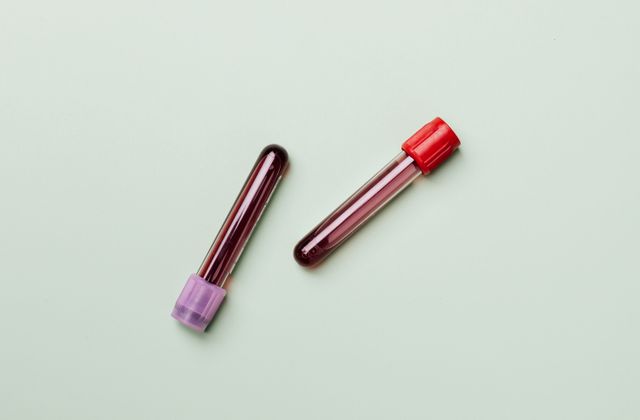
The needle prick is one sharp pinch that lasts a couple of seconds, then a dull pressure as the tube fills. Most people wince more in anticipation than from the actual prick. Then the needle is out, a cotton ball gets pressed to the spot, and a strip of tape holds it in place. You will have a small round dressing on your inner elbow for the rest of the morning, and a genuine excuse to skip lifting anything heavy with that arm.
One tube, ten minutes, done. No fasting, no waiting room, no parking hunt. The report lands in about 24 hours, and at our lab the collection team comes to you.
Getting it done without leaving your house
This test often gets ordered at moments when leaving the house feels like a project. That is exactly what home collection is for.
Call 84250 40353 and the collection team comes to your door instead. The visit costs nothing extra anywhere across Malad, Kandivali, Borivali and Goregaon, our Malad lab runs around the clock, and the report is usually in your hands within a day. One less thing to arrange.
If the doctor has suggested a full first-visit workup rather than one standalone test, two health packages cover exactly this situation. The Pregnancy Confirmation and First Visit Panel, Standard bundles the hCG test with the other early-pregnancy baselines in one visit, including the thyroid profile that doctors check routinely in pregnancy (we have written about the thyroid test itself here). For couples still in the planning stage, the Pre-Pregnancy Planning Panel, Standard wraps the workup into one visit, and doctors sometimes suggest a fertility angle too, like the AMH test. If you are not sure what to book, the tests page lists everything, or start from the home page.
Later in pregnancy, the same hormone gets a second job
Here is a twist most people never hear about. After those early weeks, your doctor stops ordering hCG blood tests entirely. The hormone has peaked, the placenta has taken over, and from here the pregnancy is followed with scans, measurements, and checkups. The number has done its work and retires.
But hCG does not disappear from your medical life. Months later, it can show up on a completely different report, in a completely different role. In the first and second trimesters, hCG is one of the markers used in Down syndrome screening: the free beta subunit in first-trimester combined screening, and total hCG as part of the triple or quadruple marker screens in the second trimester. In this context, nobody is asking whether you are pregnant. They are asking whether the level is higher or lower than expected for your exact week, because unusually high or low values, combined with the other markers and your age, feed into a risk estimate.
This is worth knowing for one reason: if you ever see "beta hCG" on a screening report in month three or four, do not read it with early-pregnancy eyes. The units may look familiar, the name is the same, but the question being asked is entirely different, and the interpretation belongs to your obstetrician, not to anything you remember from week five. Screening markers estimate probabilities across a population; they do not diagnose anything about an individual baby. That distinction matters, and it is the reason screening results always come with counselling rather than a bare number.
The through-line is simple. Early on, hCG is a yes-or-no question with a trend attached: is the pregnancy signalling, and is the signal strengthening? Later, it becomes one ingredient in a statistical recipe. Same molecule, two jobs, months apart. If you remember nothing else from this article, remember which job your current test is doing.
FAQs
Do I need to fast before a Beta hCG test? No. Food and water do not change your hCG level. Eat normally. If anything, drink water before the draw; hydrated veins are easier to find, which makes the whole thing quicker.
How soon after conception can the blood test detect pregnancy? Usually around the time of your missed period, sometimes a few days before. The hormone becomes detectable in blood as early as about 10 days after conception. But ovulation timing varies month to month, so "days after conception" is hard to pin down in real life. Waiting for the missed period gives you one clean answer instead of a grey zone.
Can one test confirm the pregnancy is progressing normally? One test confirms the hormone is present and measures how much. "Progressing normally" needs the trend, which is why doctors often order a second test about 48 hours later, and then an ultrasound at the right time. A single number is a snapshot; the pair is the story.
Why did my doctor order the test twice? Because that is how the test is meant to be used. In early pregnancy the level should rise clearly over 48 hours, roughly doubling every couple of days at first. The repeat is not a sign that something is wrong. It is the test doing its actual job.
Will it tell me whether I am having twins, or the baby's gender? Gender, no, and it is a question we get more often than you would think. hCG says nothing about gender. Twins, maybe as a hint: higher-than-expected levels can prompt the doctor to look for multiples on ultrasound, but the scan makes the diagnosis, never the number.
I just had an IVF trigger shot. When can I test? Not for about two weeks after the shot. The trigger is hCG itself, and it stays detectable in your blood for up to 14 days, fading with a half-life of roughly two and a half days. Any test inside that window measures leftover medication. Follow your clinic's schedule for the real draw.
Do men ever need a Beta hCG test? Occasionally, yes, in a completely different context. Outside pregnancy, doctors use hCG as a tumour marker, including for certain testicular and ovarian tumours, and for gestational trophoblastic disease. The test itself is identical; the interpretation is entirely different, which is why the context on the prescription matters.
Can the test be wrong? The measurement is very accurate, but the interpretation has traps. Testing too early gives a number too low to mean anything. A recent trigger shot gives a meaningless positive. Comparing numbers from two different labs invites false alarm. And in rare cases, low positives can come from pituitary hormone around menopause or from lab interference that a urine test can help sort out. When in doubt, the 48-hour repeat at the same lab settles most questions.
Takeaways
- Beta hCG is the pregnancy hormone, and the blood test gives your doctor an exact number in mIU/mL, not just a yes or no.
- Blood detects the hormone earlier than urine strips, usually around the missed period and sometimes a few days before.
- One number is a snapshot. The 48-hour repeat, showing the trend, is where the real information lives.
- Levels vary enormously between healthy pregnancies, and ranges differ by lab, so never compare your number across labs or against a stranger's chart.
- IVF trigger shots contain hCG itself and can confuse the test for up to about two weeks; tell your doctor about any fertility medication.
- No fasting needed, one tube, ten minutes. Free home collection across Malad, Kandivali, Borivali and Goregaon, reports in about a day.
References
- MedlinePlus Medical Encyclopedia: HCG blood test, quantitative
- MedlinePlus Medical Test: Pregnancy Test
- Mayo Clinic: Home pregnancy tests, can you trust the results
- Clinical practice guidance on early pregnancy hCG trends (Barnhart criteria via obstetric guideline): minimum 53 percent rise in 48 hours for viable early pregnancy; discriminatory levels vary by institution
Book these tests at home
Live prices · free home sample collection in Malad, Kandivali, Borivali & Goregaon
Beta HCG
- Report in 24 hrs
- Free home collection
Urine Pregnancy test
- Report in 24 hrs
- Free home collection
Thyroid Profile (T3, T4, TSH)
- Report in 24 hrs
- Free home collection
Anti Mullerian Hormone (AMH)
- Report in 24 hrs
- Free home collection
More tests related to this topic
Other Pregnancy tests you can book with free home sample collection.
Ante Natal Panel 1
- Report in 48 hrs
- Free home collection
Ante Natal Panel 2
- Report in 48 hrs
- Free home collection
Beta HCG Total, Maternal (Pregnancy) Test
- Report in 13 hrs
- Free home collection
BOH Panel
- Report in 48 hrs
- Free home collection
Double Marker Test - First Trimester
- Report in 42 hrs
- Free home collection
Free Beta HCG
- Report in 24 hrs
- Free home collection
Noninvasive prenatal Screening (NIPS/NIPT)
- Report in 48 hrs
- Free home collection
PAPPA (Pregnancy Associated Plasma Protein - A)
- Report in 24 hrs
- Free home collection
Unconjugated Estriol(E3)
- Report in 24 hrs
- Free home collection
Get more from the same visit
Health packages that already include these tests, and tests people usually add.
Frequently asked questions
Do I need to fast before a Beta hCG test?
No. Food and water do not change your hCG level. Eat normally. If anything, drink water before the draw; hydrated veins are easier to find, which makes the whole thing quicker.
How soon after conception can the blood test detect pregnancy?
Usually around the time of your missed period, sometimes a few days before. The hormone becomes detectable in blood as early as about 10 days after conception. But ovulation timing varies month to month, so waiting for the missed period gives you one clean answer instead of a grey zone.
Can one test confirm the pregnancy is progressing normally?
One test confirms the hormone is present and measures how much. Judging whether things are progressing needs the trend, which is why doctors often order a second test about 48 hours later, and then an ultrasound at the right time.
Why did my doctor order the test twice?
Because that is how the test is meant to be used. In early pregnancy the level should rise clearly over 48 hours, roughly doubling every couple of days at first. The repeat is not a sign that something is wrong; it is the test doing its actual job.
Will it tell me whether I am having twins, or the baby's gender?
Gender, no. hCG says nothing about gender. Higher-than-expected levels can prompt the doctor to look for multiples on ultrasound, but the scan makes the diagnosis, never the number alone.
I just had an IVF trigger shot. When can I test?
Not for about two weeks after the shot. The trigger is hCG itself, and it stays detectable in your blood for up to 14 days, fading with a half-life of roughly two and a half days. Any test inside that window measures leftover medication. Follow your clinic's schedule for the real draw.
Do men ever need a Beta hCG test?
Occasionally, yes, in a completely different context. Outside pregnancy, doctors use hCG as a tumour marker, including for certain testicular and ovarian tumours and for gestational trophoblastic disease. The test itself is identical; the interpretation is entirely different.
Can the test be wrong?
The measurement is very accurate, but interpretation has traps. Testing too early gives a number too low to mean anything. A recent trigger shot gives a meaningless positive. Comparing numbers from two different labs invites false alarm. In rare cases, low positives can come from pituitary hormone around menopause or from lab interference that a urine test can help sort out.
HWP Diagnostic Editorial Team
Health guides written by the team at HWP Diagnostic, Mumbai, to help you understand your tests before you book. This article is for general education and is not a substitute for medical advice - reference ranges vary between labs, so always discuss your results with your doctor. Read our editorial policy. Photos: Pexels.