Key takeaways
- AFP is a protein made in large amounts during fetal life; adults normally carry only traces.
- In pregnancy (weeks 15 to 20) it screens for neural tube defects; low levels feed into chromosome screening. Screening never diagnoses.
- Wrong dates, twins, and maternal factors move the number; labs read pregnancy AFP against your exact week.
- In chronic liver disease, AFP is surveillance every six months alongside ultrasound; the trend matters more than any single value.
- A normal AFP does not fully rule out liver cancer, and hepatitis flares can raise it without any tumour.
- CEA belongs to bowel-cancer care, not liver surveillance; every marker is read in context.
- The test needs no fasting, takes minutes, and reports usually land in about 24 hours.
Book tests from this article
Sample collected at home - free
- Alpha Feto Protein (AFP)
₹899₹1,19925% off
- Beta HCG
₹849₹1,14926% off
- Liver Function Test (LFT)
₹799₹1,44945% off
Free collection 24 hr reports
The two prescription slips
At our lab in Malad, we file the same three letters under two different kinds of worry. One requisition comes from a gynaecologist for a woman in her second trimester. Another comes from a liver specialist for someone who has lived with hepatitis B for years. Same vial, same protein, two completely different questions. How does one blood test answer both?
It happens because alpha feto protein is not really a "pregnancy test" or a "liver test". It is a protein with a day job in the womb that goes quiet after birth, and anything that wakes it up again is worth a look. Inside the lab, the assay is identical for both slips; what changes is the reference population the number is judged against and the question the doctor wrote on the form. This guide walks through both lives of AFP, plus a third life most people never hear about, and ends with what the blood draw feels like and how to read the number on your report without spiralling. If you only need the practical bit, the Alpha Feto Protein (AFP) test page has the booking details.
What AFP actually is
AFP is a protein that a growing baby manufactures in bulk. It is made mainly by the fetal liver and the yolk sac, and it drifts into the mother's blood in small, predictable amounts as pregnancy moves along. After birth, production switches off. Healthy adults carry only traces.
So when an adult's AFP climbs, something has switched the machinery back on. In practice that "something" is one of three things: a pregnancy, liver cells rebuilding themselves fast, or certain tumours that make the protein. The prescription slip tells you which of the three your doctor is chasing, and that context is everything. The same number can be reassuring in one setting and a prompt for more tests in another.
During fetal life, AFP does genuine work in the developing circulation, which is why the body keeps the recipe around even after it stops using it. Anything that damages and rebuilds liver tissue, or any tumour that behaves a little like fetal tissue, can nudge production back awake. That one mechanism explains all three uses of the test, and once you see it, the report stops looking mysterious.
Two quirks make the picture complete. First, newborns: babies are born with enormous AFP levels, over 100,000 ng/mL by some lab measurements, which crash below 100 ng/mL by about five months and settle to adult traces over the first year. This is why AFP is never used to "screen" infants; the newborn number is pure noise from a system still switching off. Second, there is a rare inherited condition where a mother's AFP stays raised after birth with no disease behind it at all. It runs in families, it is harmless, and it is exactly the kind of thing that causes a week of terror before a doctor who knows about it says the magic words. Rare, but real, and a good reminder that the number always needs its story.
The pregnancy half: what high and low are allowed to say
For the pregnant reader, AFP is a screening test, usually done between weeks 15 and 20. The word "screening" matters more than any number on the report. Screening flags who needs a closer look. It never diagnoses.
A higher-than-expected maternal AFP is associated with a higher chance of neural tube defects, where the baby's brain or spine does not close properly. Spina bifida and anencephaly are the two names you will see on the leaflets. When the defect is open, fetal serum leaks into the amniotic fluid and AFP crosses into the mother's blood at higher-than-usual levels. Cleveland Clinic notes this screening picks up roughly 8 in 10 cases of spina bifida and about 19 in 20 of anencephaly, which is why it has survived decades of newer technology.
A lower-than-expected AFP, read together with the other markers, feeds into screening for chromosome conditions such as Down syndrome and Edwards syndrome. On its own, a low AFP says very little. Inside the panel, it says more.
Your doctor will usually recheck your dates first, then arrange a targeted ultrasound, and sometimes amniocentesis if the picture stays unclear. The targeted scan is a longer, more detailed ultrasound than the routine one; the sonologist examines the spine, the skull, and the abdominal wall closure specifically, because those are the structures the AFP flag points at. Amniocentesis, where a small amount of amniotic fluid is drawn for direct testing, is the diagnostic step, but it is offered, not ordered, and your doctor will walk you through its own small risks before you decide. Most abnormal AFP screens resolve into healthy pregnancies once the follow-up is done, and knowing that in advance makes the waiting easier.
Why your dates move the number more than you think
Here is the detail that surprises people: the expected AFP level changes week by week through the second trimester. The lab compares your number against the expected level for your exact gestational age, ideally dated by an early ultrasound. If your dates are off by even a couple of weeks, the comparison breaks.
A wrong due date is the single most common reason an AFP report looks abnormal when nothing is wrong. Correct the dates and the same blood value turns normal. MedlinePlus lists this plainly among the causes of odd-looking results, alongside two others worth knowing.
First, twins. Each baby makes AFP, so maternal levels run higher with two or more babies. That is expected, not alarming, and the lab adjusts for it once it knows.
Second, the number is adjusted for you. Labs factor in maternal weight, and sometimes age and other details, because a larger blood volume dilutes the same amount of AFP. That is why someone asks for your weight around the time of the draw. Pregnancy labs often report the result as multiples of the median, which is just a tidy way of saying "how this compares with women at the same week". A value of 1.0 means exactly average for your week. The further it drifts, the more attention it gets.
So if your report says abnormal, the first question is never "what is wrong with the baby". It is "are the dates right". More AFP anxiety has been cured by a redated ultrasound than by any other single step.
AFP never travels alone in pregnancy
Doctors rarely read pregnancy AFP by itself. It usually arrives with the beta hCG test and one or two other markers in what labs call a triple or quadruple marker screen. Each marker looks at the pregnancy from a different angle, and the lab software weighs them together into a single risk estimate.
The logic is simple enough. High AFP points one way, low AFP with high hCG points another, and the combination is far more informative than any marker alone. The third and fourth markers play supporting roles: unconjugated estriol, made by the placenta and the baby's liver working together, and inhibin A, a placental hormone added in the quadruple screen to sharpen the chromosome-risk estimate. None of them means much alone. Together they form a pattern, the way a few instruments make a chord. Our beta hCG post walks through the other half of that pair, because understanding hCG makes the AFP number much easier to read.
Timing is the whole game here. The window is roughly weeks 15 to 20, and the lab needs your exact week to interpret the result. Book it against your gynaecologist's dates, not a guess, and tell the lab if a dating scan changed the week. A well-timed test with right dates is worth more than a rushed one with wrong dates, every single time.
When the panel report comes back, the headline is usually a risk figure, written as "1 in" something. A screen-positive result simply means your number crossed the lab's cutoff and you are being offered the next step; it does not mean the condition is present. A screen-negative result means the pattern looks ordinary, though no screening test catches everything. Reading the figure as a probability, not a prophecy, is the single most useful skill for this report.
The liver half: surveillance, not screening
Now the other prescription slip. For someone with chronic hepatitis B, long-standing hepatitis C, or cirrhosis, AFP is a surveillance tool for hepatocellular carcinoma, the most common primary liver cancer. More than 80 percent of these cancers arise in livers that were already fibrotic or cirrhotic, which is why doctors watch this group closely instead of waiting for symptoms.
The surveillance routine, per the American Association for the Study of Liver Diseases, is an abdominal ultrasound with or without AFP, roughly every six months, for people with cirrhosis and for high-risk chronic hepatitis B. AFP alone is not a good enough net, and ultrasound alone misses things too. Together they catch more, and that is the point of the pairing.
About 70 percent of people with hepatocellular carcinoma have raised AFP, per Mayo Clinic Laboratories. Read that the other way around: nearly a third do not. Some tumours produce little or none of it. That is why a normal AFP in a liver patient never means "all clear", and why the ultrasound stays non-negotiable. Your doctor is reading the trend across visits, not grading any single number.
In practical terms, this is the test that shows up on a six-monthly liver follow-up slip next to your liver function test and an ultrasound booking. If you are being followed for chronic hepatitis B, the HBsAg (hepatitis B) test is the one that tracks the infection itself. AFP is the one that watches for what the infection can eventually lead to. Same liver, different questions.
A few practical points doctors emphasise. If hepatitis C was the original problem and the new antiviral tablets cleared it, the cancer risk drops a lot, by roughly seventy to eighty percent, but it does not drop to zero. Surveillance continues after the cure, and your doctor should tell you this explicitly, because patients understandably assume a cured infection means the story is over. Also, surveillance has its own decision tree. A tiny nodule under a centimeter usually just gets a repeat ultrasound in three to four months. A nodule above about a centimeter, or a suspicious AFP jump, moves you from surveillance to diagnostic imaging, typically a contrast CT or MRI. Knowing this ladder in advance makes each step less frightening, because nothing in the sequence is improvised.
The flare trap: when a healing liver raises AFP
This is the part that causes more panic than any other paragraph in this guide, so it gets its own section. AFP can rise when the liver is simply healing.
A hepatitis flare, active inflammation, cirrhosis doing its slow damage: all of these can push AFP up with no tumour anywhere. MedlinePlus notes AFP rises during recovery from hepatitis. In benign liver disease the rise is usually modest, staying in the tens or low hundreds at most, nothing like the hundreds or thousands a tumour can produce. Ranges vary by laboratory, so always read your number against the range printed on your own report, but the pattern holds: a mild bump in someone with active liver inflammation is the liver talking, not necessarily a cancer whispering.
That is also why timing matters in liver care. A single AFP drawn during a bad flare week is almost impossible to interpret on its own. Your doctor will usually repeat it once the inflammation settles and read the trend. Two numbers a few weeks apart, read next to an ultrasound, beat one anxious number every time. If your last liver report came with raised transaminases, tell the doctor before the AFP draw; the context changes how the number gets read.
Doctors also watch AFP move together with your liver enzymes. During a hepatitis flare, AFP and ALT tend to rise and fall in step. When the enzymes settle and AFP follows them down, that is the liver calming down, and it is one of the more reassuring patterns in this whole field. A rising AFP against falling enzymes is a different pattern, and that is the one that gets a quicker ultrasound. You do not need to memorise this; it is your doctor's job. But understanding that the numbers are read as a moving picture, not a snapshot, explains why the repeat draw exists.
The third life of AFP: germ cell tumours and the treatment watch
There is a third setting where AFP earns its keep, and it rarely gets explained well: certain tumours of the testicle and ovary, especially yolk sac tumours and mixed germ cell tumours containing embryonal elements. These cancers remember how to make a fetal protein, and their AFP output becomes a way to track them.
In this setting AFP works as a treatment monitor. If surgery removes the tumour completely, the level should fall back to normal. AFP clears from the blood with a half-life of about five days, so the fall is quick enough to watch in real time. If the value has not returned to normal roughly a month after surgery, Mayo Clinic Laboratories notes that suggests leftover tumour. And if AFP climbs again after a remission, it often means the cancer is back.
One honest caveat from the same source: a tumour that made AFP the first time can return without raising it again. The marker is a helper, not a guarantee. Imaging and the full clinical picture stay in charge, and no doctor manages one of these cancers on the marker alone.
One more detail that surprises people: these tumours do not always start in the testicle or the ovary. Germ cell tumours can begin in the middle of the chest, in the mediastinum, where stray germ cells ended up during fetal development. An AFP ordered for a young man with a chest mass is chasing the same protein for the same reason. The body is consistent, even when the anatomy is not.
Most readers will never need this section. But if your AFP order came from an oncologist rather than a gynaecologist or a liver doctor, this is probably the story behind it, and now you know why the follow-up draws keep coming.
The marker mix-up: why CEA does not belong in liver surveillance
Blood markers have a way of collecting on prescriptions, and patients understandably assume they all pull in the same direction. They do not. The CEA test is one example, though it belongs to bowel-cancer care rather than liver surveillance.
CEA is a marker used in monitoring colorectal cancer and medullary thyroid cancer. It is not a liver marker, and the surveillance guidelines for liver cancer, ultrasound with or without AFP every six months, do not include it. If your doctor orders AFP and CEA together, they are usually building a broader picture across different organs, not doubling up on the liver. The context on the prescription slip is, once again, the entire test.
This is a correction our pathology review insisted on, and it is worth spelling out: markers are read in context, and borrowing a bowel marker for a liver question is how reports get misread. When in doubt, ask your doctor which organ each marker on your slip is watching. The answer is usually one sentence, and it clears up more confusion than any amount of internet searching.
Reading your report without panic
Reports land, numbers stare back, and the first instinct is to compare with a number you saw online. Resist it. Reference ranges genuinely differ from laboratory to laboratory, sometimes substantially. One lab's adult range and another's can disagree outright, which is why you should read your value only against the range printed on your own report. The pathology review of this very article flagged exactly this: respected sources quote different adult cutoffs, so this guide quotes none. Your report's own range is the authority.
A few steady rules help. First, AFP is a trend test in liver care and a week-sensitive test in pregnancy. The single value is the least informative version of the result.
Second, pair it with its companions: in pregnancy, the rest of the marker panel and the ultrasound; in liver care, the liver function test and the ultrasound. Two reports side by side tell a fuller story than either alone. Third, learn what your own report's units are saying. Pregnancy reports often express AFP as multiples of the median, so a value near 1.0 simply means "average for your week", and flagged values earn follow-up, not a diagnosis. Adult reports give a concentration with the lab's own range beside it; the range is the only comparison that counts. Fourth, an abnormal result is a prompt, not a verdict. In pregnancy it leads to rechecked dates and a targeted scan. In liver care it leads to a repeat draw and imaging. The number starts the conversation. It never finishes it.
One more habit helps more than people expect: keep every past AFP report and look at them as a sequence, not as single snapshots. A liver patient whose values read 14, 12, 15 across three visits has a flat, boring story, which is exactly what you want. A patient whose values read 9, 18, 45 has a climbing story that earns the quicker ultrasound, even though 45 on its own is not a diagnosis. The same logic runs in pregnancy: the point is the fit of the number to the dates, not the number alone.
And the question we hear most at the counter at our Malad lab is never about the needle. It is "when do I get the report", and the answer is usually within about 24 hours.
Your questions, answered
Do I need to fast before the AFP test? Usually no. AFP by itself needs no fasting and no special preparation. Just check whether your prescription includes other tests that do, and follow the fasting instruction for those.
How long does the AFP report take? About 24 hours from the time the sample reaches us. Home collections from Malad, Kandivali, Borivali and Goregaon go out the same day, so most people have the report in hand the next day.
I am pregnant and my AFP came back high. Does that mean something is wrong with the baby? Not necessarily. A high AFP only flags a higher chance of a neural tube defect and starts a closer look. Your doctor will first recheck your dates, since wrong dates are the most common cause of an odd result, then arrange a targeted ultrasound. Screening picks up roughly 8 in 10 cases of spina bifida, and most flagged pregnancies turn out fine after follow-up.
My dates were off by a couple of weeks. Does that change the reading? Yes, often completely. The expected AFP level shifts every week, so a result that looks high at week 18 can be perfectly ordinary at week 16. Redating the pregnancy fixes many "abnormal" results without any further testing.
I am carrying twins. Will my AFP be higher? Yes, and that is expected. Each baby makes AFP, so levels run higher with two or more babies. Tell the lab; the interpretation adjusts once it knows.
My doctor ordered AFP for liver monitoring. Should I be worried? AFP rises for benign reasons too, including liver regeneration during a hepatitis flare. In liver care it is a surveillance marker, so the trend over several tests matters far more than any single value, and imaging completes the picture.
Does a normal AFP rule out liver cancer? No, not fully. Roughly a third of liver cancers produce little or no AFP. That is why surveillance pairs the blood test with an ultrasound every six months rather than relying on either one alone.
What is the triple or quadruple marker test? It is a panel of second-trimester blood markers: AFP plus beta hCG, estriol, and sometimes inhibin A. Each marker looks at the pregnancy from a different angle, and the lab weighs them together into one risk estimate. AFP is one voice in that panel, not the whole story.
I had a hepatitis flare recently and my AFP is up. Is that cancer? Probably not, though only your doctor can say. Flares and liver healing push AFP up on their own, usually into the low hundreds at most. A repeat draw once the inflammation settles, read next to an ultrasound, is how doctors tell the difference.
Can I get the AFP test done at home? Yes. It is a routine venous blood draw, and our phlebotomists do it at your doorstep across Malad, Kandivali, Borivali and Goregaon. Book on 84250 40353.
The draw: five minutes, no fasting, one cotton ball
For all the weight this test carries, the procedure is as ordinary as blood draws get. You do not need any special preparation for AFP, per MedlinePlus. No fasting. Eating or drinking does not change the result. The one real caveat: glance at your prescription. If your doctor added other tests that do need an empty stomach, fast for those and the AFP simply rides along.
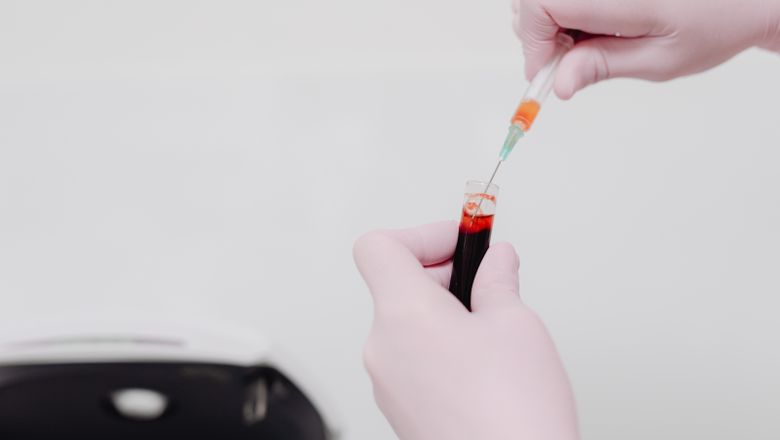
The draw takes less than five minutes. The needle prick feels like a quick sting or pinch at the inside of your elbow, then the tube fills while you are still deciding whether it has started. At a home collection, our phlebotomist ties the tourniquet, taps the vein into view, and the whole thing is over in seconds. The tubes get labelled right there at your doorstep, which is one of those small details that matters more than it sounds: your sample's identity is fixed before it ever enters a bag. A cotton ball gets taped to your arm with white tape that will peel a little sleeve fuzz off later. The most common after-effect is a small bruise at the spot, which fades in a few days.
Because no fasting is involved, you can book this test at any hour that suits you. Evening home-collection slots exist precisely for people who cannot step out during work hours, and the 24x7 lab means a sample drawn at night gets processed the same way as one drawn at noon. If your prescription bundles AFP with fasting tests, take the morning slot and do them all at once; if AFP is alone on the slip, pick whatever time keeps you calmest.
Getting it done in Mumbai
If the AFP was ordered for pregnancy screening, you may have done a first-trimester pregnancy confirmation and first-visit panel (basic) a few weeks ago. AFP is simply the next step of that same workup, in the right week this time. If it was ordered for liver follow-up, drawing it alongside your regular liver panel keeps everything on one report, which your doctor will thank you for. You can browse the full tests page if your prescription has more names on it, or the health packages page when a broader checkup makes sense.
The logistics need one short paragraph. Bookings take a minute on 84250 40353. Home collection is free across Malad, Kandivali, Borivali and Goregaon, and the lab itself is open round the clock. Reports usually land within about 24 hours, so most people have the number in hand the next day.
Do:
- Do: bring your prescription and your ultrasound dating scan, especially for pregnancy AFP.
- Do: tell the lab your current weight; it goes into the calculation.
- Do: check whether your prescription bundles other tests that need fasting.
- Do: keep your past AFP reports; the trend across visits is what your doctor reads.
Don't:
- Don't: compare your number with ranges you found online; ranges vary by laboratory.
- Don't: panic at a single abnormal value; an abnormal AFP starts a workup, it does not finish a diagnosis.
- Don't: assume a normal AFP rules out liver cancer; the ultrasound stays part of surveillance.
- Don't: skip the follow-up your doctor orders after an abnormal result; the follow-up is the point of the test.
If your slip says AFP and nothing else, the booking is the easy part; it is the interpretation that deserves care. Bring every past report you have, mention any recent illness or new medicine, and ask your doctor one plain question at the next visit: what would make this number reassuring, and what would make it worth repeating?
References
- MedlinePlus (U.S. National Library of Medicine), Alpha-Fetoprotein (AFP) Test
- Mayo Clinic Laboratories: Alpha-Fetoprotein (AFP) Tumor Marker, Serum test catalog
- Cleveland Clinic: Alpha-Fetoprotein (AFP) Test
- American Association for the Study of Liver Diseases (AASLD) hepatocellular carcinoma surveillance guidance, via the U.S. VA viral hepatitis guidance summary and the 2021 Cochrane review of ultrasound and AFP surveillance in chronic liver disease
Book these tests at home
Live prices · free home sample collection in Malad, Kandivali, Borivali & Goregaon
Alpha Feto Protein (AFP)
- Report in 24 hrs
- Free home collection
Beta HCG
- Report in 24 hrs
- Free home collection
Liver Function Test (LFT)
- Report in 24 hrs
- Free home collection
HBsAg (Hepatitis B Surface Antigen)
- Report in 24 hrs
- Free home collection
Carcino Embryonic Antigen (CEA)
- Report in 24 hrs
- Free home collection
More tests related to this topic
Other Cancer tests you can book with free home sample collection.
Arthritis Screen Profile (4 Marker)
- Report in 48 hrs
- Free home collection
Beta 2 Microglobulin
- Report in 24 hrs
- Free home collection
Bone Resorption Markers
- Report in 24 hrs
- Free home collection
Brain tumour
- Report in 24 hrs
- Free home collection
CA 125 (Ovarian Marker)
- Report in 24 hrs
- Free home collection
CA 19-9 (Pancreatic Marker)
- Report in 24 hrs
- Free home collection
CA 19.9
- Report in 24 hrs
- Free home collection
CA 72.4
- Report in 24 hrs
- Free home collection
CA125
- Report in 24 hrs
- Free home collection
CA15.3
- Report in 24 hrs
- Free home collection
Calcitonin
- Report in 24 hrs
- Free home collection
Cancer Detection Panel - Male
- Report in 48 hrs
- Free home collection
Get more from the same visit
Health packages that already include these tests, and tests people usually add.
Frequently asked questions
Do I need to fast before the AFP test?
Usually no. AFP by itself needs no fasting and no special preparation. Just check whether your prescription includes other tests that do, and follow the fasting instruction for those.
How long does the AFP report take?
About 24 hours from the time the sample reaches us. Home collections from Malad, Kandivali, Borivali and Goregaon go out the same day, so most people have the report in hand the next day.
I am pregnant and my AFP came back high. Does that mean something is wrong with the baby?
Not necessarily. A high AFP only flags a higher chance of a neural tube defect and starts a closer look. Your doctor will first recheck your dates, since wrong dates are the most common cause of an odd result, then arrange a targeted ultrasound. Screening picks up roughly 8 in 10 cases of spina bifida, and most flagged pregnancies turn out fine after follow-up.
My dates were off by a couple of weeks. Does that change the reading?
Yes, often completely. The expected AFP level shifts every week, so a result that looks high at week 18 can be perfectly ordinary at week 16. Redating the pregnancy fixes many abnormal results without any further testing.
I am carrying twins. Will my AFP be higher?
Yes, and that is expected. Each baby makes AFP, so levels run higher with two or more babies. Tell the lab; the interpretation adjusts once it knows.
My doctor ordered AFP for liver monitoring. Should I be worried?
AFP rises for benign reasons too, including liver regeneration during a hepatitis flare. In liver care it is a surveillance marker, so the trend over several tests matters far more than any single value, and imaging completes the picture.
Does a normal AFP rule out liver cancer?
No, not fully. Roughly a third of liver cancers produce little or no AFP. That is why surveillance pairs the blood test with an ultrasound every six months rather than relying on either one alone.
What is the triple or quadruple marker test?
It is a panel of second-trimester blood markers: AFP plus beta hCG, estriol, and sometimes inhibin A. Each marker looks at the pregnancy from a different angle, and the lab weighs them together into one risk estimate. AFP is one voice in that panel, not the whole story.
I had a hepatitis flare recently and my AFP is up. Is that cancer?
Probably not, though only your doctor can say. Flares and liver healing push AFP up on their own, usually into the low hundreds at most. A repeat draw once the inflammation settles, read next to an ultrasound, is how doctors tell the difference.
Can I get the AFP test done at home?
Yes. It is a routine venous blood draw, and our phlebotomists do it at your doorstep across Malad, Kandivali, Borivali and Goregaon. Book on 84250 40353.
HWP Diagnostic Editorial Team
Health guides written by the team at HWP Diagnostic, Mumbai, to help you understand your tests before you book. This article is for general education and is not a substitute for medical advice - reference ranges vary between labs, so always discuss your results with your doctor. Read our editorial policy. Photos: Pexels.